Saturday, July 13, 2013

Benevolant Government?

South Burlington, Vermont

IRS scandal, DOJ scandal, NSA scandal:  There is certainly lots of reason recently to undermine our confidence in the federal government.  This is not a political blog, so I won't be commenting on those contemporary scandals.  However, I will comment on things we saw recently on our trip.

The Rockpile Museum in Gillette, Wyoming has a special section devoted to the subject of homesteading.  The map below says that by 1900 95% of Indian lands had been lost to homesteading.


A placard in the museum also says:
The result of the United States expanding westward was devastating to many American Indian cultures.  The Government continued a long tradition of mistreatment, negotiating meaningless treaties, initiating wars, cutting off food supplies, and forcibly removing tribes from their traditional lands.  Tribes were moved to barren reservations where their survival was dependent on the U.S. Government. Most American Indians were unable to participate in homesteading until 1924 because they were not permitted to become U.S. citizens. 
The poster below reflects the sanctity afforded to Indian reservation lands.  It shames me to have my heritage on the wrong side of this history.


A few days later, we arrived at Devils Tower.  Devils Tower is regarded as sacred land by the Lakota Indians.   It became a national park in 1906, but how the land became U.S. Government land is not mentioned.  The Lakotas requested that the National Park Service forbid climbing on the tower.  They refused.   Instead, the National Park Service asked for a voluntary ban on climbing in the month of June, when Indians gather there for religious ceremonies.  We were there in mid June, and we saw climbers ignoring the voluntary ban.

June 15, 2013

A few more days and we were at The Crazy Horse Memorial in South Dakota.   It was a bit jarring.  It memorializes more than Chief Crazy Horse.   It also memorializes all the Indians who fought against Custer's troops in The Battle of the Little Bighorn.  But wait; these Indians massacred U.S. soldiers!  Were they heroes or domestic terrorists?

Well, if you think like I do, those Indians were just as much Americans as the white man.  The U.S. Government was not being benevolent, it was corrupt and tyrannical. Unlike Confederate soldiers in The Civil War who fought for politics, the Indians were fighting for survival.  I think Crazy Horse, Thomas Jefferson, and Edward Snowden are all entitled to admiration for their willingness to sacrifice personal safety to fight for liberty.  Only Jefferson is honored by a memorial in Washington D.C.


Is the U.S. Government primarily benevolent or tyrannical today?  Are the laws really "of the people, by the people, and for the people?"  We teach school children only the benevolent spin.  I believe that the trend is definitely toward tyranny.


Friday, July 12, 2013

Written In Stone

South Burlington, Vermont

I have been working on editing the pictures of our western trip. It's a massive job because there are ~3000 of them! When I'm done, I'll extract a 100 image slideshow, the best of the pictures and I'll post that online.

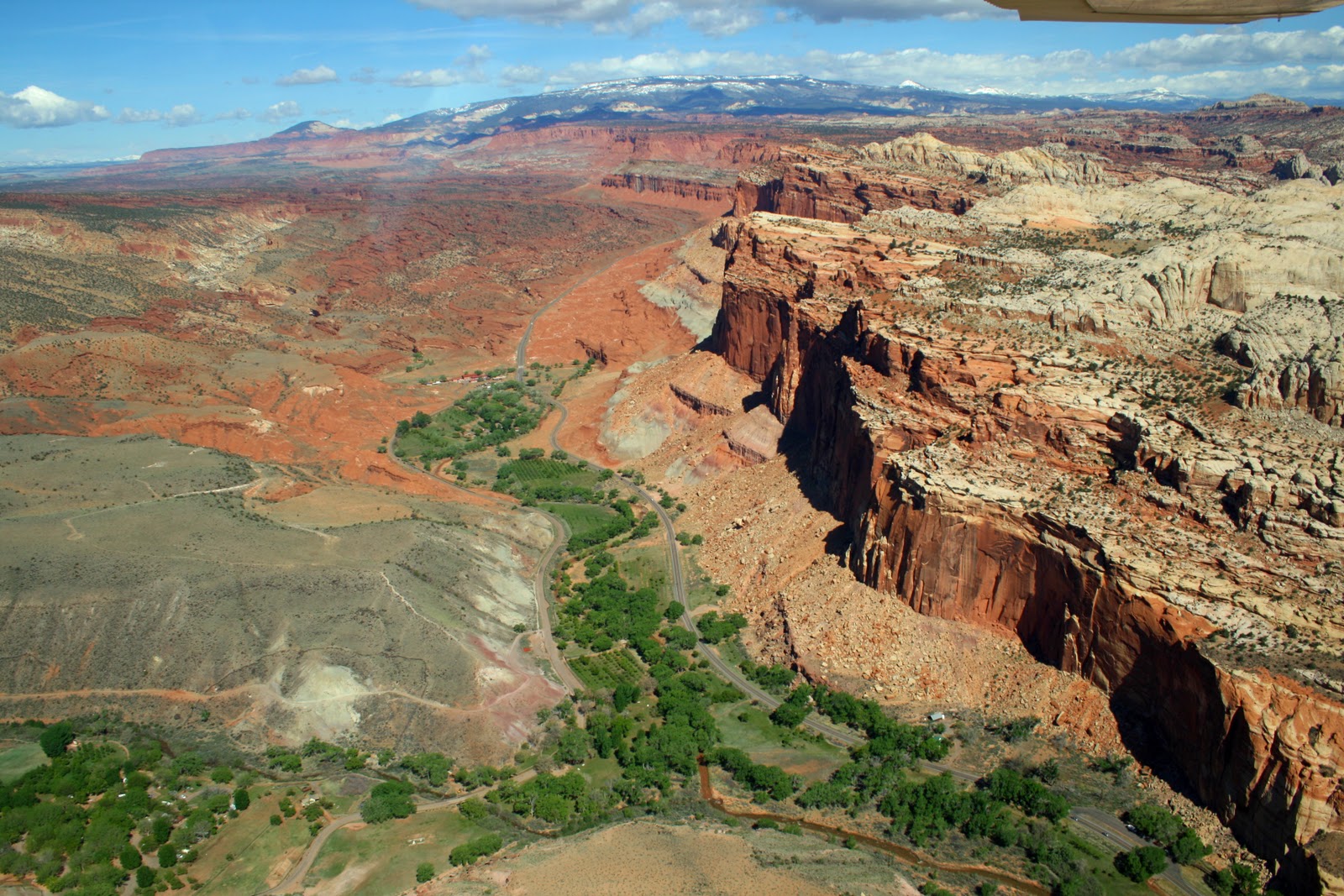
A memorable highlight of the trip was Capitol Reef National Park. It is centered on The Waterpocket Fold, which we toured 125 on a dirt road. The geology is not only beautiful, but scientifically interesting. In an effort to understand the geology myself, and to find aerial pictures of the fold, I came across the Written In Stone blog by Doctor Jack Share. It is a wonderful blog with many great pictures and explanations of the associated geology. Rather than me explain it, I recommend that you simply visit Written In Stone yourself.

Two posts in particular attracted my attention. They center on an aerial flight Doctor Stone took in the Colorado, Utah, Arizona region. Lots of fun. Read these posts part 1 here and part 2 here.

Aerial view of Fruita, in Capitol Reef. A favorite spot of ours. Posted with permission of
 

Thursday, July 11, 2013

Regrets

South Burlington, Vermont

What regrets do we have from our trip?   Of course, for every place we visited there are countless equal or better places we didn't visit.   One can't regret them all.

More specifically, we drove a spectacular 80 miles on Utah Route 12 between Escalante to Capitol Reef.   It was wonderful.  In 2010, Dave and I were enchanted by this road.  In 2013, it was Libby and I and the enchantment repeated.   However, this time as we approached Boulder, we found signs describing Hell's Backbone Road.   It sounded grand.  

I now regret, not backtracking 38 miles, so that we could do it a second time using the Hell's Backbone route rather than Route 12.  I'm afraid that the urge to press forward and not backtrack was too strong.  Darn.


Hell's Backbone-Bridge, 1500 feet down either side.


Wednesday, July 10, 2013

Rattled Confidence 2

South Burlington, Vermont

In Rattled Confidence, I mentioned New York, Vermont, Alberta and Saskatchewan.  That is because those are the places I heard having trouble with flooding. After this week's news, let me add the province of  Ontario to the list. Of course, other states may also be affected, but I haven't heard about their problems on the news.

Of course, inconvenience to me and other boaters is an insignificantly small part of the story.   If these rain patterns become the new norm, what are some of the long term consequences?    For one, I foresee the farm belt of the USA moving several hundred miles north.   That would raise interesting problems if thousands of US farms might be abandoned and the farmers (or farming corporations) want to move north into Canada.

Another drastic change would be that the wet areas might need major new dams to control flooding.  I am thinking of dams as large as the Grand Coulee and Glen Canyon, and lakes behind them as big as Lake Mead and Lake Powell.  In these highly populated and developed areas, that would be a major upheaval.  

Imagine a map that looked like this.  Add to that evacuation of coastal areas.  Add to that changes elsewhere in the world.


Should we wring our hands in despair?   I think not.  In any other context we consider change to be necessary for societal vitality, and lack of change a recipe for stagnation and demise of great nations.  Fresh water could become the most valued of all natural resources.  Why should we not look upon climate change as a great opportunity?

It is politics, not nature, that could transform beneficial change into disaster.  Think of the politics of national borders.  A necessary part of embracing this change and making it positive must be global removal of restrictions on large scale migrations of people.