Wednesday, December 28, 2011

Special Effects

Marathon, Florida
24 42.40 081 N 05.68 W


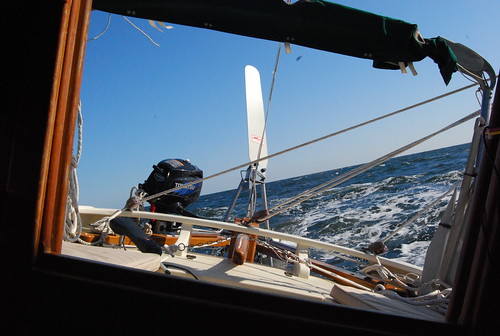
The camera app in my Droid has some neat special effects. Don't you agree?

Tuesday, December 27, 2011

Wanderlust

Marathon, Florida
24 42.40 081 N 05.68 W

I find myself bitten by wander lust yesterday and today.  We've told people we're staying here in Marathon, but still.   (Cruisers tend to be evasive when people ask about their plans.  Having announced plans is a drag on impulsive decisions to do something different.)

We could take a day trip out into Florida Bay and do some exploring on the Bay side of the keys.  

We could take a major excursion up the west coast to Sarasota.  We've never been there before north of Caya Costa.    If we did that, we could begin with a visit to the Dry Tortugas.  We liked that very much when we were there in 2005.

We could change our minds about the winter and head for the Bahamas.  We couldn't leave immediately because I haven't bought a 2012 US Customs decal yet.  The decals take many weeks to arrive.

Lately, we've been hearing very nice things about Rio Dulce in Guatemala.  I don't think we'll do that this year, but maybe soon.


Monday, December 26, 2011

Prescient

Marathon, Florida
24 42.40 081 N 05.68 W
Anyone who claims to label hem/her self as prescient is way out on thin ice.  In this case though, I can't avoid it.  Here's the story.

I got a Kindle for Christmas.  Hooray!  It is the newest touch model, sans all buttons except on/off and Home.  I also go the insurance policy that covers breakage and loss including liquid spills.  I wouldn't have dared without it.

Now flash back.  It was 1998.  I was between jobs and had some time on my hands.  The Internet was just approaching puberty. I had my own personal web page since 1994, but now there were very many sites online.  We had browsers, but GOPHER and USENET were still the major tools.  I took advantage of the circumstances.  I found a program called NAPSTER.  It was a neat tool for locating and downloading free music in MP3 format.  Those were the days before the music industry noticed and got defensive.

I used NAPSTER to download more than 600 of our favorite musical pieces.   Of course, we didn't have any way to use those MP3 files.  Playing music on the PC wasn't useful.  There was no such thing as portable MP3 players in 1998.  Still, I collected them and archived them.

I also found a place on USENET with ebooks.  They were downloaded in a klunky hexadecimal ASCII text format; each in part A, B, C, ... partial pieced.  It was a lot less slick than NAPSTER, but it worked.  I downloaded 105 books that were on my wish list to read.   Of course, I didn't have any way to use the files.  Reading on a PC screen, (or later a laptop screen, or even a Droid screen) was uncomfortable and useless.  Still, I collected them and archived them.

Over the years, I carefully archived those files and transferred them to each new computer.  I stored the books in several file formats to assure compatibility with future needs.

When the iPod came along, and later the first Kindle.  I eschewed buying them.  I did not want to pay for a device that did nothing until I went to their online store (iTunes) and spent a lo  ore money.  They were walled gardens, and I refuse to play that way.

Yesterday, I was able to take advantage of my nearly 14 year old preparations.  I put all those books and all that music on my Kindle.  It took only 15 minutes.  Everything works fine.  I can read my books while listening to my music in the background, all on one device.  Amazing.

I can't really say that I specifically visualized the Kindle in 1998.  Nor could I specifically foresee the bruising battles over online downloads.   Nevertheless, my preparations seem prescient if I do say so myself.


Saturday, December 24, 2011

Star of Bethlehem

Marathon, Florida
24 42.40 081 N 05.68 W


How do you like our Christmas tree?  It is made of rosemary.  It is very cute, and it is just the right size for a boat.  It even smells nice.   [Actually, that's causing a conflict. I think the nice smell is too strong and I want to store it out in the cockpit.  Libby wants it down in the cabin.  We'll have to duke that one out.]  


Christmas Eve is the proper time for a Star Of Bethlehem type celestial event; right?   Well, if the local clouds will dissipate, Boot Key Harbor will get to see one tonight.  At 6:54:44 PM tonight, 55 degrees above the horizon to the NE, we'll see a very bright Iridium flare, magnitude -8.  What is that?  Iridium satellite phones are served by low orbit satellites.   Just after sunset, or just before dawn, when it is dark down here and sunny up there, the solar panels reflect the sunlight.  If the panel points directly at your eye (like a signal mirror) you see a bright flash.  Such will be the case here tonight.   If you are not in Boot Key Harbor you won't see it, the effect is quite local.  However if you go to heavens-above.com you can find out when Iridium flares are visible where you live.


Merry Christmas

Friday, December 23, 2011

Mister Monitor

Marathon, Florida
24 42.40 081 N 05.68 W

I never blogged before about Mr. Monitor.  He's one of most important crew members.  Actually, Mr. Monitor is our pet name for our self-steering gear.   When at sea, we engage Mr. Monitor immediately upon departure and let him steer Tarwathie until we reach port once again.

Those who have never sailed offshore don't appreciate the need for self-steering.   It is very impractical to steer manually 24 hours per day, day after day.  First of all, one needs sleep, potty, and food, sail trimming, and other breaks while on duty.  Secondly, human attention drifts as does the course.  Thirdly, it is exhausting; especially with tiller steering.  In rough seas after four hours on the tiller my muscles begin to knot and cramp.  The solution to all of that is to find a way to make the boat steer itself.

Joshua Slocum, the first man to sail alone around the world, was an expert sailor.  He sailed Spray mainly by adjusting the sails.  Then, according to his book, he would drop a loop of rope down on the appropriate spoke in his steering wheel to lock it in place.  Slocum wrote that he did that leaving Austraila and never needed to touch anything again until landing on a tiny island 8000 miles away.  Bulls... I say.  Even Slocum wasn't that good.

Today, many boats rely on electronic autopilots for self-steering.  They do a marvelous job, when they work.  "When they work," is the operative phrase.  Unfortunately, one of the most frequent stories we hear about offshore passages is that, "my autopilot stopped working."  In my humble opinion, they are far from reliable enough to depend on offshore.  They can break down.  They are also vulnerable to lightning hits or near hits that can wipe out all electronics on board in a microsecond.

We have a tiller master electronic autopilot, but we use it only on the ICW and inland waters.  It isn't adequate for offshore.  However, I once met another Westsail 32 whose skipper told me that he used an identical tiller master on a trip to England and back.

Instead of an autopilot, a so-called wind-vane type of self-steering is most appropriate for offshore sailing.   Ours is a Monitor brand.  I've been told that Monitor is the Cadillac of self-steering gear.  Some people like their own brands.  I'm not expert on comparing different brand.  Suffice it to say that the Monitor is solidly built, rugged, and seaworthy for one or more circumnavigations with little or no maintenance.   (If you watch the video below, you'll see a much cheaper self-steerer made with plastic parts.  It is certainly not sea worthy.)

So, what is a wind-vane self-steering gear?  It is the odd looking stainless steel thing hanging of the stern end of our boat.   The most common question we get from non-cruisers is, "What the heck is that thing!"   In the picture below, you see the Monitor at the stern of Zaftra (the W32 belonging to our frieneds Don and Gloria in Vero.)


In the following picture, you see a monitor in action at sea.  Nobody is at the tiller.  The Monitor is in control.    The Monitor keeps the boat at a constant angle to the wind.  That means if the wind shifts, your course shifts with it.  That's optimum in terms of speed and sail trimming, but it does mean that you need to pay attention and to readust the sails and the Monitor after a significant shift.   Holding course with a wind vane means +/- ten degrees.   It hold the course on the average.  When racing, an alert human can steer better than a wind-vane.  Note the qualifier; alert.


By Ben Eriksen


So, how does it work? Sigh. That's difficult to explain. I never understood it myself until we experienced Mr. Monitor in action. Fortunately, thanks to youtube.com you can watch the video below. It is not a Monitor brand, but the video does a much better job of illustrating the principles than my words can. Key to the servo-pendulum method is that it takes power from the motion of the boat though the water to make very powerful forces to move the tiller (or wheel). The rougher the conditions and faster the boat speed, the more powerful the Monitor's actions. It is more than enough to turn a massive rudder.


Video: Mister Vee